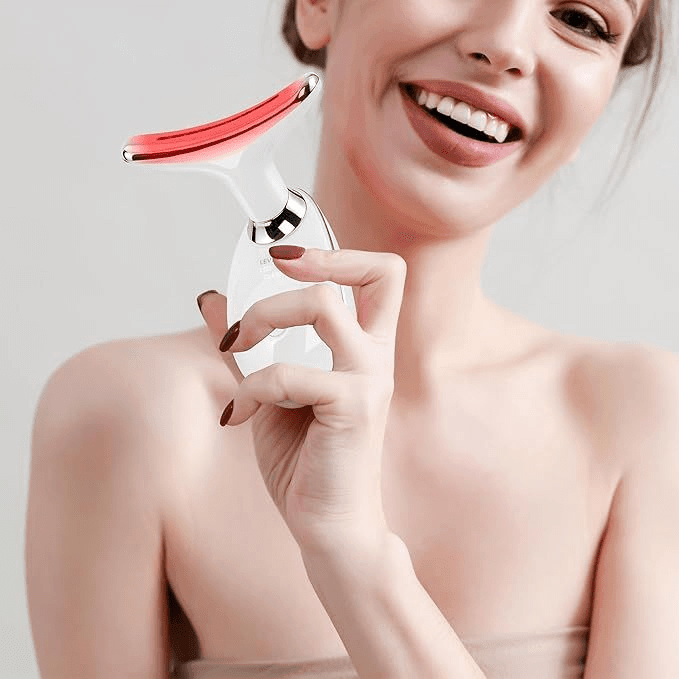
A face mask you can strap on and a handheld wand can both feature red light, but they ask for quite different things from your evening. One stays in place. The other needs your hand, your attention and a little more planning.
If you are choosing between an LED face mask and a red light wand, start with the area you want to cover and the way you actually like to use a skincare device. The shape of the tool matters. So do its instructions, light settings and any extra functions.
The practical difference: fixed coverage or a handheld tool
An LED face mask is shaped around the face. Once it is fitted according to its instructions, the light sources stay in their intended positions during the session. A handheld wand has a smaller treatment head, so you position or move it as directed.
That does not make one format automatically stronger or more effective. You cannot judge the light reaching your skin from the size of the device, the brightness in a photo or the number of LEDs alone. The specifications and instructions for the exact model still matter.
When an LED face mask makes more sense
A mask is worth considering if your main interest is a facial routine and you would rather set the device up than guide it around your face. With the GlintSkin LED Face Mask, the first thing to assess is the fit: look at the shape, straps and openings, then check the current product information for the settings and accessories included with your chosen option.
Think through a normal evening. Is there a comfortable place where you can use it as instructed, then clean it and put it away? Can you reach the controls without pulling on a cable? Those details may tell you more about whether you will use it regularly than a dramatic product demonstration.
A mask is also a fairly specific purchase. Do not assume a facial model is suitable for your neck, scalp or body simply because it emits red light. Use it only on the areas covered by its instructions.
When a red light wand or facial sculptor may suit you
A handheld device may appeal if you enjoy a more involved skincare step. You can hold the tool and follow its prescribed movements, rather than wear a mask. Before choosing one, find out whether the head should glide, remain still or be used with a particular product. There is no single technique that applies to every wand.
The GlintSkin 7-in-1 LED Facial Sculptor is a handheld option in the range. Its product listing describes light settings alongside other functions. Read those functions separately: instructions for a device that combines light with electrical stimulation or warmth are not interchangeable with instructions for an LED-only mask.
A smaller head also means paying attention to coverage. Do not multiply the session time or repeatedly work over one spot in an attempt to match a mask. Follow the schedule for the device you own.
Five details to compare before you buy
1. The area the device is intended for
Choose a tool designed for the area you want to use it on. A facial opening, curved head or larger light surface tells you something about the design, but the instructions should confirm the intended use.
2. What happens during a session
Check whether you need to hold the device, move it in a particular pattern or adjust a strap. If you dislike hands-on routines, a wand may feel like another task. If you dislike wearing something over your face, a mask may sit unused.
3. The exact light specifications
Look for the wavelengths and operating modes of the specific model, rather than relying on a color name. If two listings give different figures, ask for clarification before deciding. A higher number on a specification sheet is not, by itself, a reason to choose one device.
4. Extra modes and preparation
Some handheld tools combine several functions. Check which can be switched on separately, what preparation each requires and whether a gel or other accessory is needed. Do not borrow a serum routine from a different device without checking compatibility.
5. Cleaning, storage and support
Look at the care instructions, charging arrangement and space needed to store the device safely. Read the current warranty and return terms as well, including any conditions for an opened or used product. Keep a copy of the instructions for your exact model.
Do you need both?
Usually, the more useful first step is choosing one device that fits a clear purpose. Owning two does not establish that using them together is appropriate, or that the results will be better.
If you already own a mask, write down what you want a wand to add. A different handling style is a concrete reason to compare them. A promise that more devices must mean faster changes is not a reliable basis for a purchase. Check with the manufacturer before combining sessions or modes.
A few questions that come up when choosing
Is a red light wand the same as a microcurrent device?
No. Light and electrical stimulation are different functions, although a single tool may offer both. Read the mode descriptions and restrictions for the individual product. Do not treat every illuminated facial tool as the same type of device.
Can a wand replace a full-face LED mask?
It may suit someone who prefers a handheld routine, but it is not a direct substitute with an equivalent schedule. Coverage, operating modes and instructions differ. Choose by intended use rather than trying to convert the timing of one device into another.
Which is easier to keep using?
The one whose setup you are willing to repeat. Before ordering, read the use and care steps from start to finish. If you can picture doing them on an ordinary Tuesday evening, you have a more useful starting point than a routine built around a perfect spa night.
Compare the GlintSkin LED Face Mask and 7-in-1 LED Facial Sculptor with those practical questions in mind. For a closer look at the mask routine itself, see our LED mask usage guide, and follow the instructions supplied with your device.